

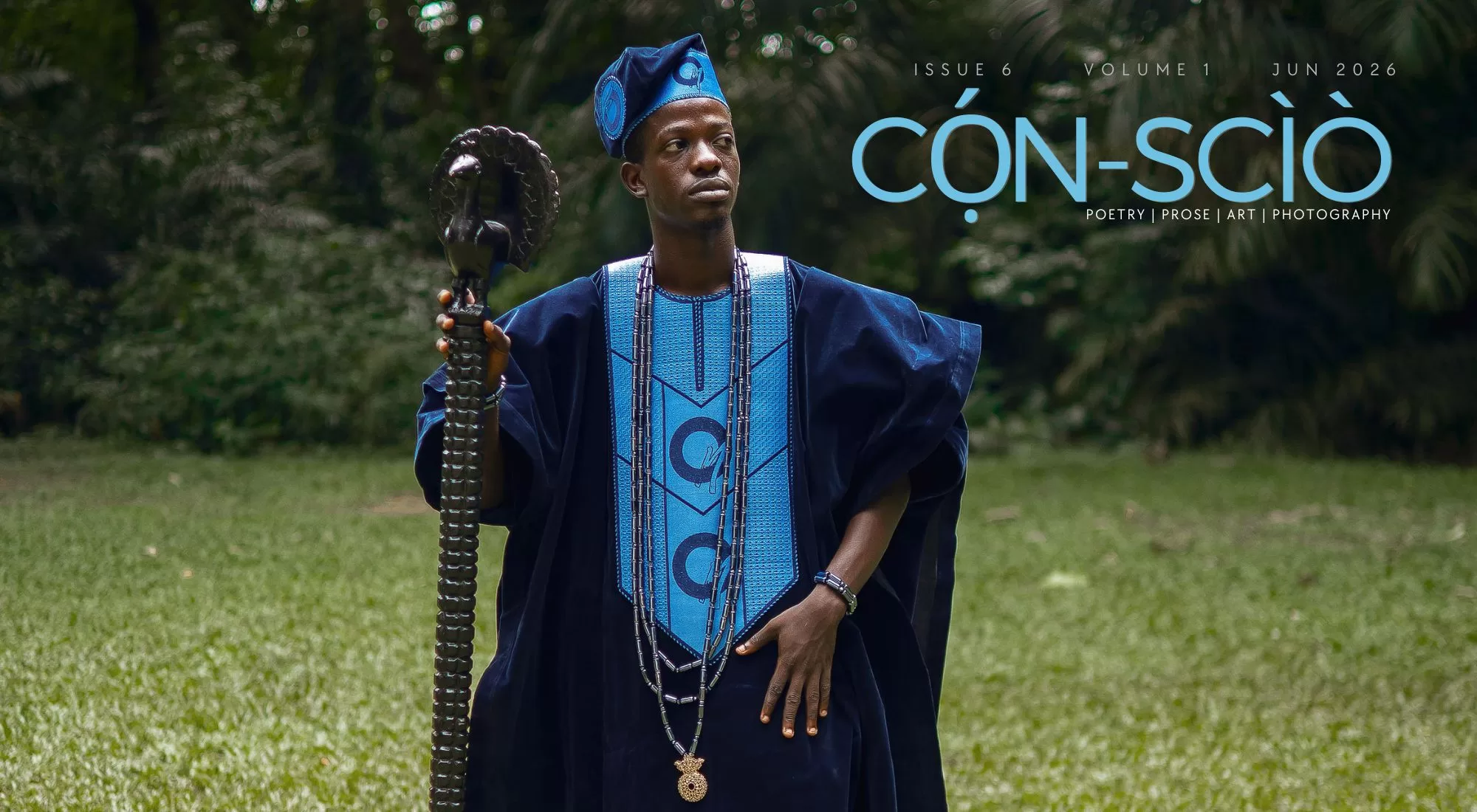
Yusuf Àlàbí Balógun, popularly known as Àrẹ̀mọ Gemini, is a Nigerian performance poet, novelist, and cultural advocate whose work bridges Yoruba and English traditions. A self-taught artist, he has built a distinctive career redefining the relationship between talent and cultural legitimacy, with a self-professed mission to propagate and preserve Yoruba arts and language. His practice is rooted in grassroots realities and the conviction that art must serve as a vehicle for empathy, emotional honesty, and social reflection. Since debuting in 2017, he has performed at major international platforms, including the Aké Arts and Book Festival, the Lagos International Poetry Festival, and the San Francisco International Arts Festival. Moving from English-language poetry to a deliberate focus on Yoruba, he authored the novels Ṣẹ̀gílọlá Arómirẹ́ Ògìdán (2023) and Ìṣẹ́pẹ́ (2025), which blend traditional literature with modern themes like social justice and grief. Àrẹ̀mọ is also the founder of the Jomitoro podcast and a recipient of the Horn of Afroclassical Merit Award for Excellence in Arts and Culture. Through his diverse narrative work, he continues to document lived realities while challenging audiences to imagine culturally grounded futures. In this conversation with guest editor Sarah Adeyemo, Àrẹ̀mọ Gemini discusses his self-assigned role as a custodian of the Yorùbá language, the influences that shaped his art, and his aspirations as an artist to reach a global audience through multi-genre art.
SA: As you navigate your craft, who are the contemporaries you feel are walking this same path with you? Furthermore, what is the experience of working alongside them—or drawing inspiration from the heritage of those predecessors who have passed on?
GẸ̀MINI: I prefer to think that I’m a poet and storyteller who works within the intersection of languages and truths. So, while it’s quite true to say that a lot of people believe that I’m a Yorùbá poet, I think it’s quite limiting for me to run with that tag only. I work extensively with the Yorùbá language in my work, but in the same space, I have works in English. In fact, my most recent win from the Afrobeat Rebellion Poetry Slam, which was largely a run of English poems, also gives credence to that. I love to say that if I could learn any other language, I would equally create art using those languages.
Away from that clarification, I’m very big on the fact that the road less travelled is not less of a road. I do not think that a totally foreign language can sufficiently capture the nuances and realities of original Yorùbá stories. And while most of the stories I tell are not peculiar to Yorùbá-speaking people alone, one thing that locks them in is the grassroots connection. I cannot tell the story of the people below the pyramid in a language that struggles to capture their truths. As an expressionist, I owe it to myself first to create in a language that I can fully think in, and it is safe to say that I process my thoughts in the Yorùbá language.
It is quite easy to run with cliches and define culture as this or that. But when the chips are down, the death of a language automatically spells the death of a culture. Once there is a scarcity of people speaking and creating in a language, that language gradually begins to wear off, and the values tied to it, therein, fall apart until there is nothing else to return to.

When a group of people lose their value, they become roaming ghosts. Beyond wishing that the Yorùbá language, amongst other languages, does not fade into oblivion in forty to fifty years from now, one of the most active steps to champion that resurgence is to create spellbinding arts with it. It is a lonely road, but sometimes, one person must take the risk of crossing the bridge, so others can see that it is very possible.
SA: The name Àrẹ̀mọ Gemini carries a certain weight and mystery. Could you take us back to the moment it was conceived? What is the story behind the identity you’ve built?
GẸ̀MINI: As a secondary school student, I had adopted “Gemini”, which was my astrological sign, as a moniker for my works (It is important to note that I’ve been writing from the cradle). That pseudonym grew with me into the artsy scene, and at the point where I had to cross majorly and heavily into Yorùbá oral arts, it was necessary to find a name that speaks to my mission. Àrẹ̀mọ was the bridge between the English name and my pursuit.
It was also a way of paying homage as an “heir” to the predecessors ahead of me, who, though they did not fully get all their deserved flowers, paved the path that I now tread. Years later, the name “Àrẹ̀mọ Gemini” is now evidence of my versatility and ability to morph art in Yorùbá as “Àrẹ̀mọ” yet still do excellently in English as “Gemini”.
SA: The shift in your linguistic focus is quite profound. Having started your literary path in English with Days of Infirmity, you’ve now firmly established your voice through the medium of Yoruba. What was the catalyst for this evolution, and how does your perspective on that debut English work differ now that you are rooted in indigenous storytelling?
GẸ̀MINI: Yes, I was still in secondary school when I wrote that pamphlet. It is one of those books I read now and cringe, LMAO. But that was definitely one of the defining moments that gave birth to the author of Ṣẹ̀gílọlá Arómirẹ́ Ògìdán and Ìṣẹ́pẹ́, years later. To be candid, I’ve always written works in English and Yorùbá from childhood — mostly playlets. As someone who consumed a lot of Ajílẹ́yẹ’s movies while growing up, I’d always have to return to my exercise books to write my own version of the story, especially when I felt it could have ended in a better manner.
Deciding to put out novels in Yorùbá, years later, was not a mistake. It was basically a certain moment to come to life. In the years between and even at this point though, I’ve learnt, unlearnt and relearnt so many things in terms of penmanship, storytelling medium, language use and deployment. The growth is evidently one of the reasons why I’ll read “Days of Infirmity” now and cringe. I’m still in the process of becoming.
SA: I think most writers can relate to that ‘cringe’ when reading their old work! But moving on to the bigger picture of language sustainability: at a time when traditional cultures and indigenous languages are fading, what does being a protector of the Yoruba language look like to you?
GẸ̀MINI: Being a custodian of the Yorùbá language today is about responsibility, discipline, and relevance. Deep literacy is key. Yorùbá supersedes spoken sounds. It is philosophy, history, the science of thought, and a tonal system that carries meaning in ways English cannot.
A custodian must study it seriously, understand its grammar, proverbs, oral literature, Ifá corpora, poetry, naming systems, and the worldview embedded in them. Love is not enough if you cannot commit to studying. Studying is in vain if you do not love what is being studied. It takes two to tango.

It is important to know that a language survives because it is spoken in markets, homes, art, classrooms, and now in digital spaces. Custodians need to bear the responsibility of speaking, performing, teaching, arguing, joking, and tweeting with the language. If we say a language is alive, then it must not have a reason to exist in the past tense.
A language that cannot describe the modern world will be abandoned.
Preservation is a step; innovation is a bigger step, and a stage. Custodians must expand the language by creating new metaphors, adapting it to technology, film, music, literature, and scholarship. A language that cannot describe the modern world will be abandoned. A custodian makes sure Yorùbá can talk about today without losing its soul or getting watered down.

When you put all this together alongside audacity, you must not forget to pass the baton with humility and a sense of continuity. No one owns the language. You receive it, refine it through your practice, and pass it on better than you met it. You must always remember that custodianship is a relay, not a throne.
SA: How much of your current craft is rooted in your personal history? I’m curious if there were storytellers or foundational narratives in your youth that set you on this path toward storytelling.
GẸ̀MINI: I grew up in a household where my dad was a trado-medical doctor and an Ifá diviner. My mom, albeit into conventional trade, was from a line of drummers, otherwise known as “Àyàn”. Experiencing heritage and spirituality from a primary root, as opposed to what was popular to many of my peers (particularly with western religions) led me into seclusion, as I had few neighbourhood friends. My only medium of expressing the things that I saw or imagined while in this space was through writing.
Also, judging from my primary structure, I had no choice but to consume heavy doses of Yorùbá TV shows and movies. From Nǹkan Ńbẹ to Lábẹ́ Ọ̀run, down to Late Alhaji Yẹ̀kínì Ajílẹ́yẹ’s movies, Ògúndé’s, Jimoh Aliu’s et al., I am very loud on the idea that we are what we consume heavily, because the combo of these movies and old school classic songs not only fueled my storytelling energy but also channelled it towards the arcs I chose to write from.
SA: That’s a powerful perspective. You’ve mastered both the written words in your novels and the spoken words on stage. If you had to choose, which medium do you feel truly captures the essence of the stories you want to tell?
GẸ̀MINI: I operate within every genre. I have not even fully unravelled myself in other mediums, as much as I’ll want to. As an expressionist, I do not pick one over the other. I move with the tides and embrace them all with the same respect. I do not have a specific preference.

SA: The trajectory of Segilola’s life in your debut novel serves as a vessel for exploring systemic issues like misogyny and cultural taboos. Given the emotional depth of her decision-making process, how closely do you identify with her character, and what were the real-world inspirations that shaped the ‘why’ behind this work?
GẸ̀MINI: Well, I tell a lot of women stories. Perhaps growing up as an only son in a home filled with women had its own impact. I had a close, richer perspective of how patriarchy, misogyny and a male-dominated society cripples the efforts of women right from birth. While I cannot wholly and intimately relate to these stories in a sense (as it takes a woman to know what it feels like to be a woman), I cannot deny the need to empathise.
I cannot deny the need to call out these ills, because silence in the face of tyranny is a higher complicity. Works like “Ṣẹ̀gílọlá Arómirẹ́ Ògìdán” is my attempt at igniting these conversations, having women question their own decisions, especially in conversations of love, deliberately sabotaging oneself to grease a man’s ego. You cannot teach others how to love you if you do not even love yourself enough. That lack of self-love and awareness was, in fact, the Achilles heel of Ṣẹ̀gílọlá. To be candid, there are more Ṣẹ̀gílọlá(s) in our world than we know, and my debut novel was just a gentle tap for us to look in that direction.
SA: Ìṣẹ́pẹ́ feels like a very deliberate piece of storytelling. What was the ‘why’ behind this book, and which prominent themes do you feel define its emotional and social landscape?
GẸ̀MINI: Ìṣẹ́pẹ́ embodies so many themes in one. It is a story that came to me while grieving the serial loss of my father and sister in 2021, and it spans through sidelined narratives of marginalised folks, women, widows, lovers, and late bloomers. As an attempt to prevent the complete erasure of women with labels from the front pages, Ìṣẹ́pẹ́ humanises the realities of plaguing widows and their immediate societies. The conversation of black tax and the cruelty of “former poor folks” to current poor folks is quite loud in Ìṣẹ́pẹ́. I believe that poverty comes with a stench, and if you pay attention well, you can notice it regardless of how much one has washed. Poverty dehumanises people and, in this book, I stripped that conversation to the minimal bits.
SA: Talk to us about Jomitoro. What inspired you to bring Yoruba storytelling into the podcasting space, and what is the core objective driving the show?
GẸ̀MINI: I have always fancied the idea of podcasting, but like every other thing I do, I’ve never wanted to do it through the normal route. I had three key reasons for starting Jomitoro – the first being the need to have podcasts tailored in native languages. I’m very big on the need for native languages to incorporate every field and find their space there, as there is always an audience for every market, regardless of how untapped. Secondly, I wanted to document my mother’s thoughts and, by extension, take a peek at the truths of the older generation. I wanted to weigh the contrasts of our realities, ethics and values, whilst having uncomfortable conversations that the majority will not have with their older ones. Jomitoro – as the name implies, “to discuss”, is a constant boiling pot where my mother and I share our takes and thoughts on every and all topics in a healthy manner. It is my way of preserving what’s left and redefining what we can hold onto. The last but perhaps most personal reason is the culture of memory. Beyond pictures, I want to be able to reference lineage with audio and video. When my mother eventually transitions in years to come, I want to be able to revisit her philosophy, ideals and flaws – not just by merely recounting but by revisiting these documented recordings that capture her in her raw, honest form.

SA: Expanding on that idea of sustainability: in an increasingly digitised world, how do you, as a custodian, bridge the gap between ancient traditions and modern technology to ensure our cultural legacy survives the transition?
GẸ̀MINI: Digital spaces are the new village square. If custodians are absent, algorithms will replace them with caricatures. Preservation now requires creating credible, thoughtful cultural narratives on social media, archives, podcasts, performances, films, and interactive platforms. The goal is not virality but continuity. Visibility without integrity is noise.
Tradition must adapt to survive. But tradition must not BEG.
Each generation meets culture through its own tools. A custodian reimagines heritage in forms that speak to contemporary sensibilities while remaining rooted in original principles. This might mean (and of course, not limited to) digital storytelling, hybrid performances, online classrooms, or collaborative archives. Tradition must adapt to survive. But tradition must not BEG.
However, a custodian must practice discernment. Not everything sacred should be uploaded. Some knowledge survives because it is protected, contextual, and earned. Preservation includes knowing what to reveal, what to translate, and what to guard. We must be careful not to “contentify” our essence, in the name of sharing and meeting up with the public glare.
SA: I’m curious about the mechanics of your work. How do you approach writing specifically for performance, and what does your process look like from the first draft to the final delivery?
GẸ̀MINI: Well, I am committed to research before writing. It is easy to create from a shallow place, but the repercussion is that people who are well informed will always discover your shallowness and put you in your rightful place. Particularly because of the sensitivity attached to the stories I tell, I consume a lot of materials and dig through actual humans. I don’t believe in the idea of rushing to create. As of now, I’m sending in this response, which is a month and some days into the new year. I haven’t written any new complete body of work, but I’ve been tinkering with ideas, and I’ve been running through story arcs, plots, finding holes, witnessing the story come to me rather than me hastening to the story. That is an essential, lasting process. And when I’m done writing and I’m ready to show the world through the stage, I commit to rehearsals every passing minute till I’m on stage.
I tend to record my poems in voice notes and play them on a loop while I’m sleeping at night. I wake up to the audio playing repeatedly and somehow end up internalising them the same way one would get an earworm from music.
…You must be comfortable with the fact that you cannot create for everybody.
You do not wait for war before you scramble for your sword. No holidays, no days off. Of course, I rest when nature requires, but I am too stubborn to fall into slumber. My job is not done until it is done.

SA: When you perform in Yoruba, you are navigating a space where not everyone in the audience may be fluent in the language. How conscious are you of that linguistic barrier during a performance, and how do you bridge that gap for the uninitiated?
GẸ̀MINI: I’ve always been one who believes in the idea that “your tribe will find you, vice versa”. By tribe, I do not mean the standard dictionary definition. I speak to the idea of people who share similar ideologies, truths and beliefs, which ultimately defies language. This goes to say that there are folks who understand the Yorùbá language yet are not my audience, because the connection just does not exist. And in the same vein, some folks who are non-Yorùbá speaking attend my shows, purchase my books and engage with my art. Language is but a medium; there is so much attached to art which has to do with the rhythm of the soul.
If we choose to bring it to the practical aspect, one of the major reasons why I step heavily into performance poetry is to be able to infuse other forms of art into what I do on stage, beyond regular rendition.
By combining music, theatre, and digital sound into what would have ordinarily been a solo rendition, there are multiple bridges to the hearts of the audience. And somehow, they’ll always resonate. Anyone who still finds it impossible to connect is simply not your audience, and that is why other forms of art exist. You must be comfortable with the fact that you cannot create for everybody.
SA: As you navigate your craft, who are the contemporaries you feel are walking this same path with you? Furthermore, what is the experience of working alongside them—or drawing inspiration from the heritage of those predecessors who have passed on?
GẸ̀MINI: The idea of success and strides is quite relative. However, if we look at poetry and literature from a commercial aspect, there are loads of people who are making strides even in the new age “celebrity” sense (Havfy, Ibquake, Alhanislam, to mention but a few). However, if we tailor it to Yorùbá performance poetry and writing, I do not know a lot of people who do what I do. (It is important to say that I do not categorise myself in the same spot with modern-day chanters, hence the exception). A lot of modern-day chanters basically trade voice and work with existing Oríkì, with little or no research. I do not praise-sing, and my works are original to me; they are my intellectual properties in every sense, rather than ancestral, oral, or antique. And because of this, I could count using a pinch of salt the number of folks who do specifically what I do or at least, in the same range as I do it. It is safe then to tag myself as a loner, but then, I’m conscious of the fact that there are predecessors in yesteryears who have trodden this path, made a name and solidified impact (Olanrewaju Adepoju, D. O Fagunwa, Adebayo Faleti, Akinwumi Isola, et al). I create knowing that their voices serve as accompaniment to my path, and I do not ever get to wallow in solitude. And even when I have to wallow in solitude, it is a temporal phase.
SA: One of your most ambitious goals is to sell out the O2 Arena in London for a showcase of Yoruba oral arts and culture. Looking toward that future, how do you envision the evolution and impact of Yoruba literature on the global stage?
GẸ̀MINI: Yorùbá literature, oral arts and culture are already on the global stage. In fact, it’d be pure recency bias and lack of research to say that it’s the generation of Asake that took Yorùbá arts to the global stage. Nahhh, Yorùbá arts have penetrated the international scene a long time ago. But of course, there are several ways to kill a rat, and they are all valid ways. As someone who operates with a form of art seen as not so mainstream in Nigeria, it is pertinent to prove to a lot of people who are uncertain of this path that it is doable, even with this form of art. It is a sprint, not a marathon and every little step, every little support, even this conversation, is a build-up to O2 Arena. It is not a quest for foreign validation of our culture, totally far from it. It’s a way of reminding those who are not convinced enough that our arts are worthy enough to be global exports and appreciated commercially without losing their value. I don’t want to take “contents” to the world; I want to take art in its purest, original form to the world. And I will do it.

SA: Looking back at your own path, what is the one thing you want a newcomer in the literary or performance arts space to keep in mind as they begin to find their voice?
GẸ̀MINI: Do not fear faltering. Do not fear making mistakes. Do not fear getting rejected. Look forward to it, in fact. Make mistakes, learn from them. Those who send you rejection letters do not hate you. You are talented, but several folks are equally talented. What separates one from the other is grit, resilience, and innovation. Work intensely, knowing fully well that the distance ahead is nothing compared to the ones already covered. If the criticisms that come your way are healthy, embrace them with humility and be open to listening. I do not believe in the concept of a failed artist or a cancelled artist. If you are an artist, you’ve already won. Every other thing is a question of capitalism, material worth and what is defined as “success”. To be an artist is a prize in itself, and you must always remember that. You must always remember that an artist cannot fail.
To be an artist is a prize in itself, and you must always remember that.


You must be logged in to post a comment.