

SHORT STORIES | Narrative Landscape Press | 226 PAGES
“Corruption does not begin in the heart of elders—it is nurtured in classrooms, whispered in school hallways, and justified in the homes of ordinary people. It is a seed sown early, watered by impunity, and harvested by those who rise to power with no regard for justice.” — Faith Ose Ebhodaghe.
Every age has a depression of its time, which is found in the artistic integrity of its writers. The artist – be it poet, novelist, or playwright – explores the agencies of that change through realistic elements. In the case of the short story, the subject matter is stylised into an economy of literary ingredients. This, therefore, positions Moonbeam as an intriguing anthology that underscores not just a popular derivative of socio-cultural failures but personal experiences of their impact.
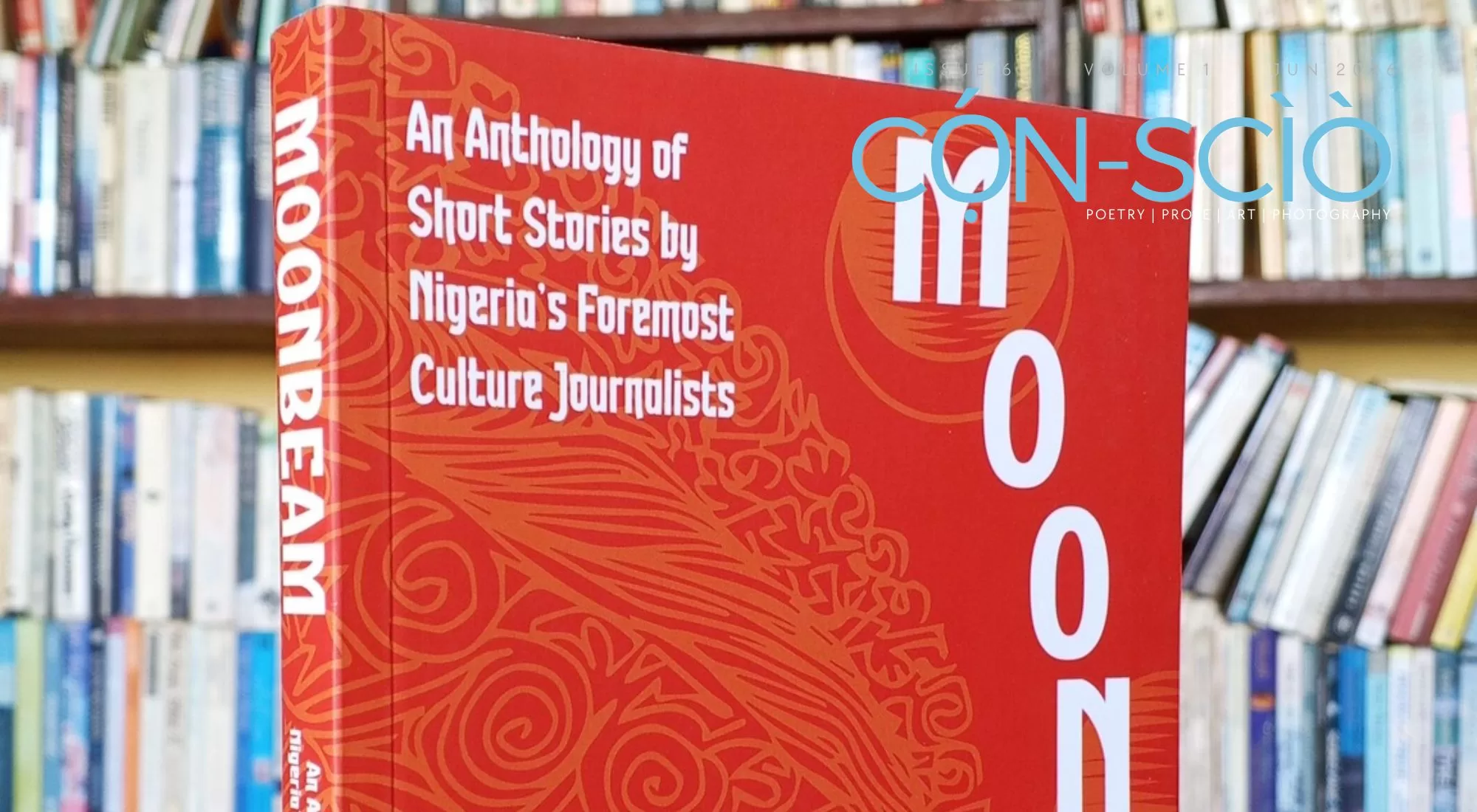
Moonbeam is an anthology of experiences written by Nigeria’s foremost culture journalists and edited by Anote Ajeluorou. There are critical stories in the collection that boast names like ‘Selfie’ by Toni Kan; ‘Sacrifice’ by Sumaila Umaisha; ‘The Book of Remembered Things’ by Abubakar Adam Ibrahim; ‘The Dead Rat’ by Akeem Lasisi; ‘Boda Alani and the Hawks: Diary of a Teen’ by Jahman Anikulapo; ‘The Wrestler’ by Sam Omatseye; ‘The House Next Door’ by Molara Wood; ‘Communal Wife’ by Anote Ajelourou; and ‘Saved by a Dead Man’ by Henry Akubuiro, to name a few.
Set in Nigeria’s notable cities across the North and the West, the stories follow the grief, loss, elusive dreams, and existential failures of their protagonists under certain conditions of disillusionment. At the heart of the anthology is inner conflict. Anisa’s condition in ‘The Books of Remembered Things’ is similar to the woman’s circumstance in ‘Communal Wife’, creating a penumbral submission of a broken generation, which remains an unresolved predicament of women under rigid customs. In this way, it is almost impossible for at least one of the stories not to resonate with the reader as a background insight into their lived and shared experience of family and social declensions. But more so is the influence of socio-cultural realities as they unfold today. Moonbeam is thus a fine blend of stories which investigate the grip of tradition, the angst of modernity, and the conflicts of contemporary society.
The most gripping feature of the anthology is its organic unity. The stories bring their protagonists into a biting conflict with their immediate world; they try to spearhead their way out of the abject disenchantment with certain systems.
The reader also experiences a sound comprehensiveness about the collection, in terms of the demography represented. This means that while one writer details women’s experiences under a hostile customary given, another explores the fantasies of young adulthood, and others the agony of an unfulfilled existence. The degrees and manifestations of these occurrences are an opulent delivery of narrative textures.
Closely related to this is the literary aesthetics of the entries. The metaphors, similes, and symbols orchestrate the reader’s experience of the stories. More importantly, the economy of space and words provides a consciousness of raw literature which is exclusive to the short story. A luminary example is Sacrifice, which tells in a few minutes the continuing discourse of political knavery – a fabric of Africa’s lament from which writers have cut their pieces of rendition. It would seem that African leaders are tactfully committed to the project of underdevelopment. While this remains a digestible nugget, a plethora of possible impacts on the reader are clearly affected by the stories. Perhaps the greatest of that signification is suspense. It is the effective deployment of this technique that affords the entries the equivalent of a novel, in addition to other techniques that facilitate the plurality of the protagonist’s representation.
Moonbeam is way beyond that nomenclature of emerging narratives. It is a foregrounding of viable traditional modes and patterns in what bearers of a value system believe about a world that works. For context, some of the stories are an exploration of traditional givens. Within that landscape, there is the quest for an explainable escape from the elusiveness of erstwhile constructs. And it is compelling how the writers yoke their suspense in the seeming irresolution of these backgrounds. The writers create a griot-like approach to the very issues that may unsettle us in today’s reality: the predictions have been drawn from the immediate post-modernist angst. An obvious example is the storytelling pattern of ‘Communal Wife’ and the confessions of the protagonist in “The Book of Remembered Things”. Also, Toni Kan’s “Selfie” is a perturbing spectacle of grief whereby the teenager Teni’s death is a metaphor of the fatal despondence among a class of social members.
The experiences, therefore, are no strange occurrences. They are the intricate nexus of two successive generations under the same climate of an almost insoluble anxiety. At this rate, the title becomes a critical viewpoint of what the reader is to expect, or what they conceive. It is either a peek into the future or a flashback from the past. This would pass for the metaphor of the title, which in itself is a cursory evaluation of the meeting points. The argument here is that the voice, tone, and mood of the stories, when taken as a unitary portraiture, belong indeed to the ilk of realistic individuals who have much to grapple with about the changes – or transitions – that alter their revered realities. This precisely is the germ of characterisation in the stories; the verisimilitude is much too palpable to be disputed as an authentic creation of socio-conscious writers.

The first and the last pieces are similar in context and predominant theme, but only differ in the cultural aspects. Even so, the emphasis on the protagonists’ hubris and self-contempt shows that the tragedy of modern society is self-immolation as a result of an intractable condition. Among others are themes such as grief, savage customs, the expense of civilisation, the failure of politics, ethnic hostility, and betrayal. The essays achieve the same exoteric situations which the novel will depict in its license to a great number of episodes, scenes and other defining elements.
Finally, Moonbeam is comprehensive. For context, the characters in the stories are exemplary figures whose conflicts reflect the layered situations of cultural, social, and, albeit tangential, political maze. The stories are practically down-to-earth investigations of personal struggles and collective depressions. More importantly, the stretch of the narratives remains within the province of the literary brilliance exclusive to the short story. The brevity of the stories is well-suited to the short story genre, yet it accomplishes an enjoyable reading experience that one can also derive from reading a novel.
Another momentous property about the text, which needs to be emphasised, is the language and style. For example, the way Jahman Anikulapo’s “Boda Alani and the Hawks: Diary of a Teen” alternates between past and present shows a unique social memory by using history and political interventions to measure personal failures. Again, Sumaila Umaisha’s ” Sacrifice” is the shortest in length but arguably the largest in the magnitude of appeal to a sense of craft. The title is a metaphor that laconically passes a commentary on capitalism. There are more instances of such hybridity and stylistic brilliance, of course. It is this fine blend of status-free representations that provides for a universality of the predicaments that move us to the core of human essence.


Kehinde Folorunsho is a literary critic and a scholar of literature. His interest in literature spans poetry, visual arts, and translation studies. He made it to the shortlist of the Atẹlẹwọ Prize for his Yoruba translation of Chimamanda’s Ngozi Adichie’s ‘We Should All Be Feminists’; shortlisted for the Gbemisola Adeoti Poetry Prize, 2025. As a book reviewer, he has been published in local newspapers. He is the recipient of the 2025 Ken Saro-Wiwa Prize for book review.


You must be logged in to post a comment.