

POETRY | 163 PAGES
“They say, in order to heal, you have to sit with your internal chaos…” — Labrinth
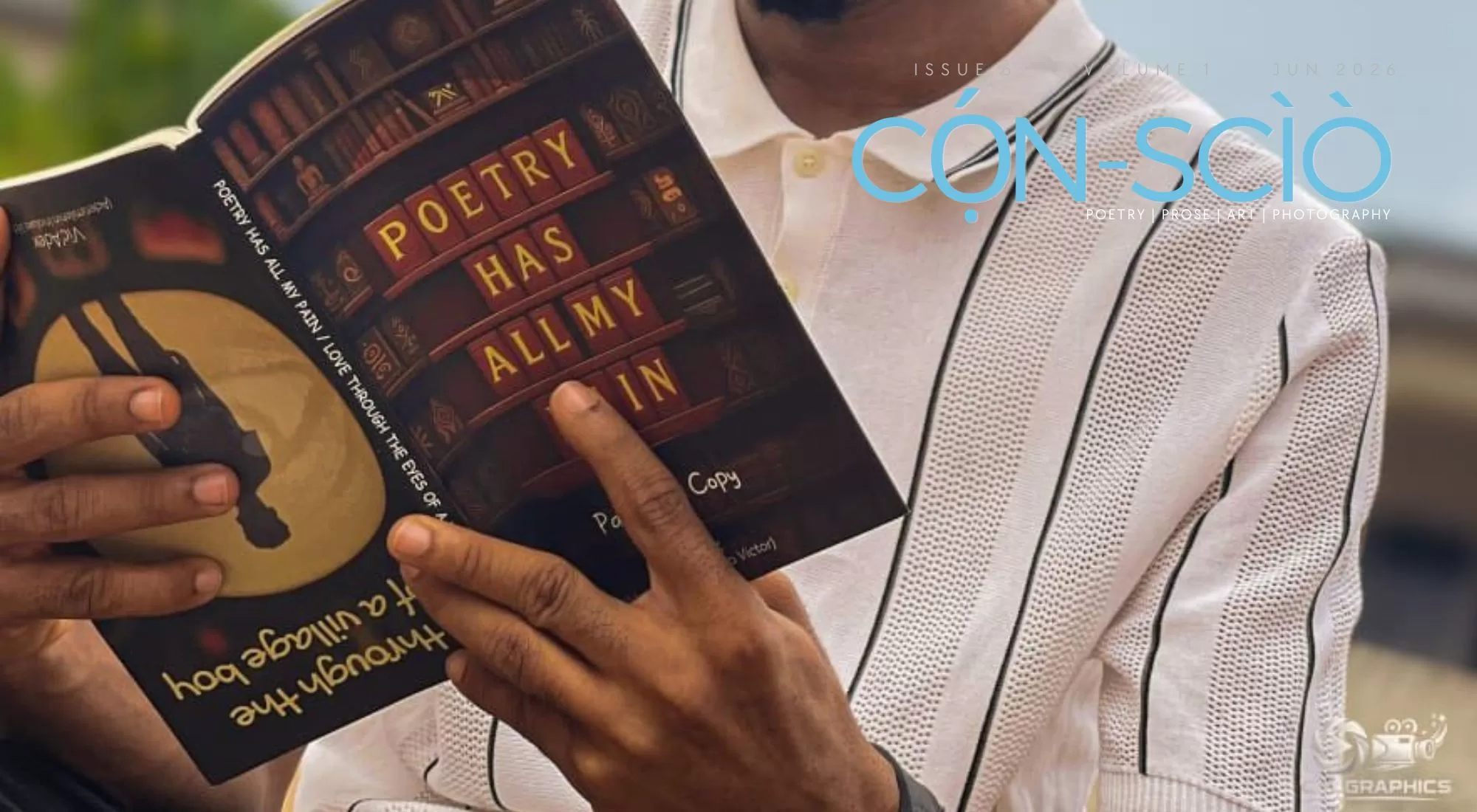
Poetry Has All My Pain is confessional and unrestrained, favouring emotional intensity over form. The poems are optimised for performance, prioritising repetition and rhetorical escalation over line breaks, white space, and compactness. The opening lines of the first poem hit you with an urgency that the book’s themes demand:
“I swore I'll never be like my father –
the villain in my pain poems, my ink-painted grief
I planned myself like a marketing brief”
The author establishes tone through self-aware, meta-poetic lines and precise imagery. The poet persona struggles for identity, navigating existential realms through the lens of a broken son trying to come to terms with the failure of a father, the ordeal of a nation, and a God whose love is strange. In this collection, the fatherhood motif is biological, theological and political.
“I planned myself like a marketing brief” is an unexpected metaphor, clean and confident. The poet is focused on (re)branding and becoming nothing like his father. “You do not become what you do not behold”, he emphasises. It’s figurative as it is concrete—ruthless. An absent father is dead, irrespective of who did the leaving. This poem becomes a refrain, taking several forms throughout the book.
Fathers are the first point of mentorship to their sons, but Vic’Adex’s verses consistently reiterate his desire not to be anything like his father. The rebellion balances on the brink of denial. In ‘Another Father Poem’, the poet admits, “I am not my father’s son”. What a paradox! There’s a stark vulnerability that reverberates in his diction; an honesty that metaphors can’t dilute. Inioluwa’s poetry is a hybrid of Biblical allusions, Nigerian vernacular, street parlance, witty puns, and scientific metaphors.
The author refuses to see the safety in family; he ponders the failure of love. How does a touch become radioactive?
“I know why it’s called a nuclear family:
Fusion is what a man does with wife…
When that fails,
fission, the breaking of an innocent soul”

(Honour, page 5)
If honouring your parents is a prerequisite for long life, he chooses death. He’d rather die than become his father. He also doesn’t want a son to inherit his battles. We don’t know the sins of the father, but we can feel the resentment in every declaration. Every promise to himself. “I do not know what a good father is / but by God / I’ll show it to my child.” I mean, it takes embracing death to live; after all, rocks are formed from decay.
The book, in its confessional stride, is also mindful of social and communal matters. Father morphs into political leaders; God becomes a metaphor for incontestable authority. This poet writes of pain yet is mindful of romanticising it. He interrogates the commodification of suffering in poems like ‘A Poet Passes in a Punchline’ and ‘We Read Poets for Their Blood’.
“We do not read a poet for his joy
His blood is our ecstasy”
Love Through the Eyes of a Village Boy features a thematic shift: a longing for healing through love. The voice is softer and devoid of the pain of the first book. It’s an exploration of desire and temptation, through a spectrum of emotional innocence (village boy) and temptation (exposure). Death becomes sweet, an offering to “a God that experimented on the universe”, an act of worship. Prayers perish at sea, and waves make a shipwreck of bones as a poet reaches for love’s shores.
This collection is rife with storm and fire imagery, leaning heavily on abstractions and aphorisms. It is a bard seeking definitions and an alternative to father-inflicted wounds. Some poems are about (or addressed to) specific lovers, some of whom are named. In these verses, the poet is happy to be vulnerable:
“I want to love you like a leaf
Blow me away with passion
Carry me in your floods”

(Love Like a Leaf).

Also, in “Baby”, the author confesses, “I’ll be 25 soon, / But with you, I’m still a child” A boy craves nurture, but this time, not of a father.
The two-in-one book format is ambitious, yet emotionally coherent. Romantic insecurity and fear of intimacy stem from paternal woes. Despite the tonal shift, the persona remained consistent, baring his anger, depression, lust, and shame in raw lines. The body that desires, bears sorrow too; grief for a father and a country. The theological thread also runs through. There’s a longing for a saviour.
The books, combined, deconstruct masculinity. Father is an archetype, and the son is either a rebel or an unwilling disciple. The battle is two-fold; when the poet persona is not fighting his father, he is fighting his own body. At the end of the day, the poet loses the battle; he becomes the person he so much dreads. “But here I am becoming his shades of darkness”, the writer resigns. He realises there may be traits he can’t help. How much of our identity is hinged on nature? How much of us do we inherit from our parents? How much of life do we understand that we’ve not lived? Clarity sometimes only comes with experience:
“I am a father too now.
And some of the things you said make sense…
Now that I am fighting the kind of battles you did,I know better than to keep kicking you.”


Jide Badmus is an engineer and poet inspired by beauty and destruction. Author of six books, including Love & Antidotes, Obaluaye, and Dawn Is An Open Wound, his poetic exploration extends to curating anthologies. Amongst other things, he is the founder of INKspiredng and CỌ́N-SCÌÒ’s Poetry Editor.


You must be logged in to post a comment.