


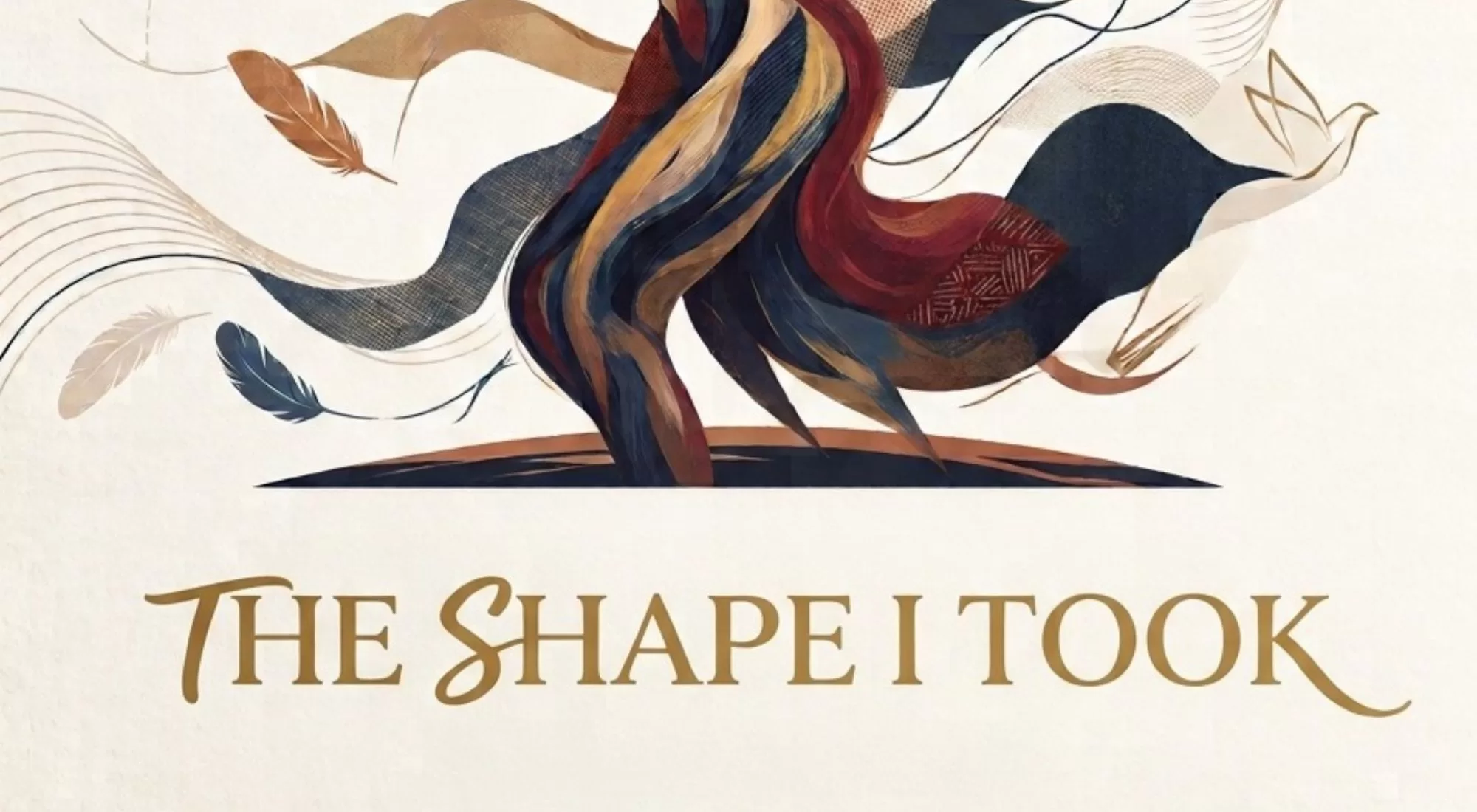
‘The Shape I Took’ is an autobiographical collection of poems that ponders selfhood. Shakirat Bioku navigates the multiple sides of relationships, migration, and purpose as she explores identity. She acknowledges that, regardless of external influences, individuals play a major role in building character. We are shaped by suffering, failures and despair, but we are not entirely products of inherited pain. We have a say in who we become.
This collection is a conversational and reflective free verse, with a bias toward the spoken word. The poems utilise short lines, calculated pauses and repetition for emotional impact. Shakirat’s commitment to clarity shows in her tendency to over-explain, even where literary devices and ambiguity would have been valuable. The drive toward wisdom and resolution becomes a recurring formula in her delivery.
The author wields duality deftly, balancing contrasting truths on emotional pivots. In ‘The House had Many Doors,’ the home is neither entirely warm nor peaceful. Family members share both laughter and gossip. Ultimately, a nurturing environment can also be full of hurt.
“The house gave me
some bruises.
It also gave me
a spine.”
The second poem highlights the imperfection and sacrificial nature of maternal love. It reinforces the idea that a positive effort can seem menacing (and vice versa); only time can reveal the truth. The poet’s mother’s perceived aloofness or avoidance is her way of cultivating character, pruning her daughter’s weaknesses and helping her confront her fears. In ‘My Mother’s Secret Language’, the conflict of a child’s confusion and perceived rejection is resolved as the adult eventually understands her real intentions and feels gratitude for the foundational guidance. She admits, “She had her own battles… // Yet she kept choosing / to fight for her children”
The next poem takes a sudden thematic shift. Migration prompts self-evaluation, a phase in which we review our ambitions and interrogate capacity. Departure is a mental exercise before the actual physical relocation. The speaker carried faith like a small suitcase for three years before she achieved her dream of moving out of Nigeria. ‘I Had Already Left’ is a transition from the retrospective tone of the first two poems. Bioku steps away from looking outward and backwards and begins to cross-examine her thoughts, judgments, and decisions. She turns the critical lens away from external influences and inherited identity towards the intrinsic.
Character is forged, mostly, in darkness and silence. Growth is not loud; it takes time to become apparent. Sometimes it takes an encounter. Shakirat admits, “There are parts of us we only meet when life becomes threatening”. These parts do not appear by chance. They are formed by constant self-appraisals.
“There is a woman
inside me
who carries a measuring tape //
She can find
the loose thread
in a room
full of fabric”

— The Things I Cannot Unsee
This collection focuses heavily on its didactic and emotional arc, while paying little attention to the art itself. The tropes and abstraction swallow moments of beautiful imagery. Shakirat conjures a strong image and then explains it. She reaches the same moral conclusion: failure doesn’t define her; she can survive adversity; she must preserve her identity; and the past doesn’t decide the future. This denies readers the chance to unwrap her lyrical gift and engage in the rigours of intellectual participation.
The poet sometimes risks vagueness by avoiding details that would make her narratives more intimate and distinctive. Characters become memorable when readers know them by names and learn their physical features and mannerisms. Specific locations and timelines enhance the ambience of events. Break philosophies into actions. Show more awareness of the environment and the bigger world. These small elements invite critical engagement and ultimately increase a book’s re-read value.
‘The Shape I Took’ explores the self as perpetually under construction through a candid, observant, intellectually curious, and vulnerable speaker who often finds her own contradictions amusing. This thematically rich, emotionally resonant debut collection is a work in progress; the beginning of an auspicious literary journey.

Jide Badmus is a poet, literary critic, and author of five poetry collections, including Dawn is an Open Wound (Noirledge Publishers, 2026), and eight pamphlets. He is the poetry editor for Con-scio Magazine, a mentor in the SprinNG Writers fellowship, and a member of the Board of Advisors for Libretto Magazine. Badmus has been nominated for prestigious honours, including Best of the Net and the Pushcart Prizes. His works have appeared in The Rumpus, Black Bough Poetry, The Nigeria Review, Agbowo, and elsewhere. Arts Council England endorsed him as a Global Talent. He writes from Nottingham, United Kingdom.


You must be logged in to post a comment.