

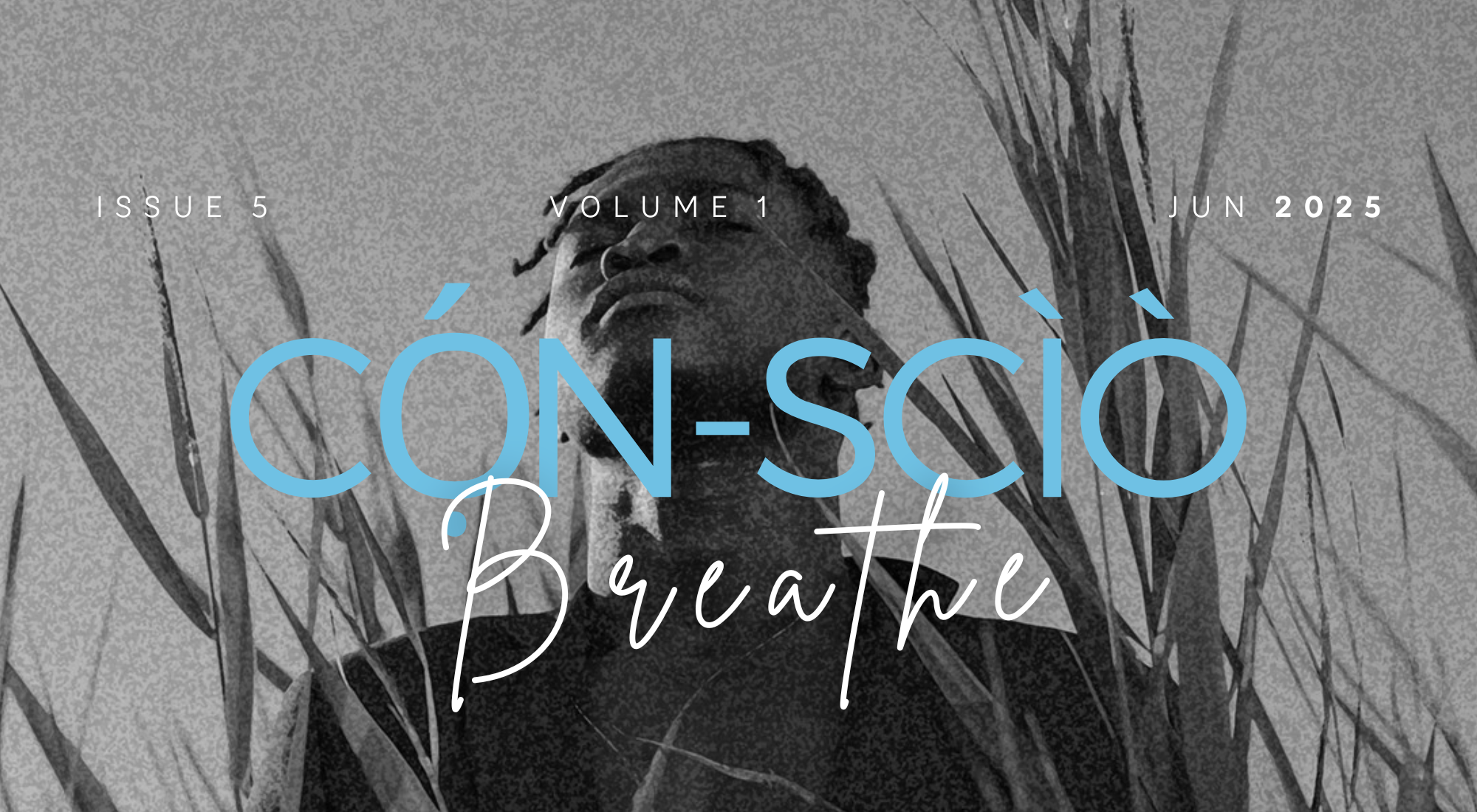
The June 2025 issue of CỌ́N-SCÌÒ Magazine (Issue 5, Vol. 1) explores the theme “Breathe” in an eclectic manner, offering something for everyone. To breathe is to live. To get some air. To take a break from things that aim to break you. To laugh a little, dance a little, make love…fall in love, perhaps.
In a world full of chaos, breathing is defiance. This is the message of Ojo Victoria Ilemobayo’s art, ‘Finding Chaos in Calm’. What an irony of a title! Similar to Victoria’s image of a lady with closed eyes, getting in tune with the Mindspace is Victor Adebayo Meye’s watercolour painting, ‘Sober Breath’, and Sulola Imran’s monochrome image, ‘Meditation’. The mind serves as a sieve for the body, filtering external noise as it reaches for healing and light. Anyanwu David Chinedu reaches for the unknown with his artwork, titled ‘Hope’, which is about harnessing your inner light, letting it wash over anxieties, and embracing what is to come. Hajani Hibard gives us a little reminder of biology with ‘Mr. Niger-D’, a depiction of the cycle of life and a powerful fusion of humanity and nature. This issue is home to visual bliss.
The short fiction pieces are simple, laced with a hint of humour, while also hanging as a socio-cultural portrait in the latter pages of the magazine. Haske Madabe’s ‘Red Flag’ is a blend of the sensual and the romantic. Koyin and Chilombo found themselves alone in the room after returning from a night out. However, a red flag threatens to cut the night short. Su’eddie’s story reminds me of Sound Sultan’s lyric, one day bush meat go catch the hunter. The story is a fast-paced adventure where everything went south pretty quickly. ‘A Dog for Butchers’ gave a whole new meaning to letting sleeping dogs lie. Michael Olobadola’s ‘Owuro’s Hunter’ is a shade darker, with Afrocentric fantastical elements. There’s a conspiracy, and a crusader threatening to unleash an age-long secret. It’s a story of betrayal and survival. A slow burn with a slight twist at the end.
And Nana Sule, our star for the issue, knows what it means to breathe: “when the world isn’t watching, I’m a baby”. She understands the responsibility of living, staying the course, but also maintaining a safe mental health space. She writes on important women’s issues, like reproductive health matters and parenting. You will discover, from our conversation with her, that breathing means growth, of mind and body, and art. She realised after selling out her debut that she had a different view of the world and a better understanding of things. Our feature’s editor engaged her about several topics, including her writing, perspectives on life and motherhood, the place of AI in creativity, and her bestselling book, ‘Not So Terrible People.’ You will enjoy the conversation.
The eight poems in this issue span a range, from the mundane to the existential. Janoma Omena’s diction is soft, and she reminds us, in ‘Sniffles and Sneezes’, that the body isn’t firewood; it sometimes forces us to take a break from our congested routine. Johan, our 11-year-old contributor, prompts us to cherish life: appreciate nature and preserve memories. ‘Breath(e) in Makoko’, by Ishola Joshua, documents the plight of a community when it rains. The loss is overwhelming—beyond the prevailing poverty, they have to deal with death. The staple of fatherless children/ is hardness. Since the breadwinner has been baked by fate.
Olobo Ejile’s poem talks of a dearth amid abundance. ‘Ode to the Discography of your Becoming’ seeks a balance of thoughts by juggling the duality of things. There are times when you have language, yet words will betray you, says a line in the poem. Similar to this is the ‘Prelude to Becoming’, written by the Imam of Poets. Abubakar Ibrahim wasn’t betrayed by words. The society teaches the boy to ignore his tender sides. Life’s fire forges the beast of survival in him. He grows into a man who does not know that softness can be a form of strength.
‘Postpartum’ and ‘The Woman Who Builds’ touch on feminine matters. Elizabeth Akinsehinwa dissects the joy and pain of motherhood—the woman lives for her children, and most times forgets to live. A pregnant woman crosses oceans to give a better life to the unborn child. Moremi Akano reiterates the creative and sacrificial nature of the woman. She is a builder, a magician, who speaks to air, moulds hope, and stitches dreams. The ambiguity in her lines is a beauty to behold.
Ferdinand Somtochukwu offers a miracle of language. Resurgence’s message is that we have a chance at healing; we only need to pause, forget where the ache started, and this is a cycle we must embrace. Iliya Kambai’s ‘Silhouette of Sunlight’ is for fatherless sons learning to be light, learning that to be a boy is not a sin to repent from, learning to count their blessings in the multitude of failure, learning to become babies again.
There are three critical reviews to balance the various narratives. Servio Gbadamosi reviews Folake Adebote’s novella, ‘The Way We Fought’, a story of trauma, endurance and internal resistance. Izang Alexander Haruna plunges into the world of ‘Impunity’, a novel by Faith Ose Ebhodaghe, a dark intersection of politics and cultism. I also served a ‘Palette of Desire’, probing into a 2022 poetry collection by Lanre Sonde titled Mellexy: Colours of You. These reviews take you on a tour of the books, the voice, style and story, without spoilers.
This latest issue of the magazine is a literary buffet. I’m only able to take the lid off for the aroma to fill the room. I invite you to take a little break from the world’s chaos, grab a cup of your favourite beverage and fill your plate with this sumptuous meal of art.
Jide Badmus
Poetry Editor, CỌ́N-SCÌÒ Magazine


