

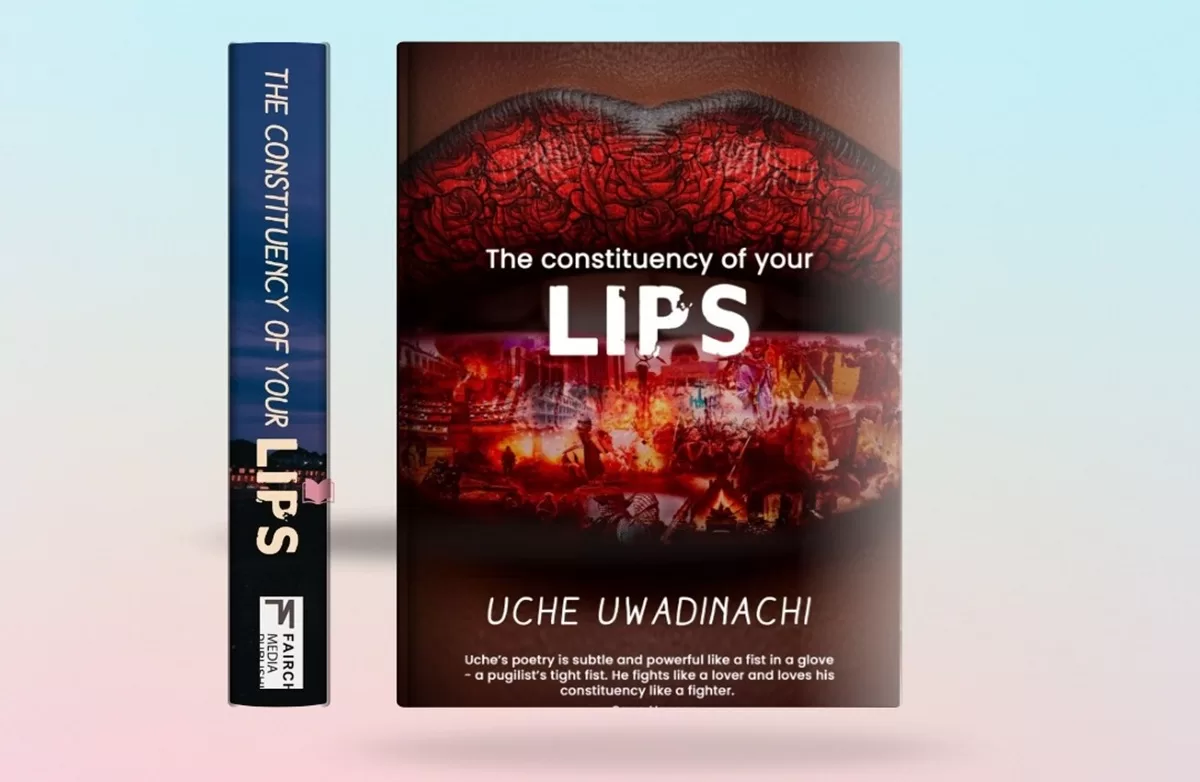
TITLE: THE CONSTITUENCY OF YOUR LIPS
AUTHOR: UCHE UWADINACHI
GENRE:  POETRY
NO. OF PAGES: ---
YEAR OF PUBLICATION: 2025
PUBLISHER: FAIRCHILD MEDIA PUBLISHING
REVIEWER:  ADEBAYO ADEGBITE
Love and politics are the two great figures of social engagement. Politics is enthusiasm with a collective, with love, two people. So love is the minimal form of communism — Alain Badiou
In “The Constituency of Your Lips”, love goes further than romantic attraction; it becomes a search for truth, an attempt to, as the author himself puts it “, interrogate that fragile space where love and leadership intersect — where the personal meets the political.” For him, love is a good lens from which to examine this relationship because Love like politics, often holds so much promise and hope, yet it also often ends in disappointment and broken promises. The purpose of the collection is to ask the questions.
The poet treats love on two levels. First, through the poet persona, he takes on the role of a lover seeking the affections of a physical woman. Like the character of Lakunle in Wole Soyinka’s “The Lion and the Jewel” (while it is a different genre, it still deals with that particular theme). He departs from the intense emotional, often pastoralist, norm of love poetry, and goes for the quippy, witty and irreverent mixing of the romantic with the urban, the sappy with the political. So, where the regular romantic poet might compare their lover’s eyes with the sun, or stars, (or other similarly beautiful/celestial/immutable objects), the poet persona says in poemXVII (p.20)
“Your eyes? Warm, pretty translucent lamps
   staring like low-current bulbs
    In Mofuloku streets…”
Of course, without the context, it would feel insulting for a lover to be compared to a “low current bulb” but someone who gets the context would not mind at all. Also, in poem “IV” (p.8), the poet declares:
If kisses are votes at primary election polls,
I would have given you enough to swear you in as the
flag bearer of my heart
If love poems are constituency projects
I would have written great lines that can cast the 2nd Niger bridge and Sea ports in the South East in two months
If hugs are in dollars, I would have sewn for you the biggest campaign Agbada and elaborate attires of different
tribes so that you will never catch cold anywhere
If love is the ultimate mandate, I would immediately
install you as the economic Messiah, with one million
posters, one million thugs, one million brown envelopes
and one million manifestos
But, all you want, is the warmth of my hands.... Please
hold.... It’s time to go see mama.
Another example of the poet Perona’s humour is in poem XIII (p.15-16) where he says
You are my boo
My boo-kata
My Boo-gatti
My boo-llion Van.
While the poet-persona as a lover is the dominant imagery in the work, there is also the more subtle image of the poet-persona as a metaphor for a Nigerian politician campaigning for votes from the people. The poet-persona’s politician, though, is a parody, making absurd declarations and promises he cannot possibly fulfil; however, with one’s knowledge of Nigerian politics, the question is whether his portrayal of the politicians is far off from their reality.
Even beyond the metaphor of the politician as a lover, A perceptive reader, upon examining the tone of the work, realises that the whole collection is in itself an allegory, and therefore what the author says in his note about “every reader being able to rediscover the courage to speak, to question, and to love again with clarity.” Makes sense in context. The tone of the poet persona towards his lover is subservient; he makes it abundantly clear throughout that he is prepared to do everything, even the absurd, to make her happy, because to him, she deserves everything good. He is even prepared to face off against her detractors, which is why in poem XIV (p.16) he says:
Babe please
Don’t flare up
You know that the voltage
of your anger is so high
that It can provoke the radial
of the sun and worsen
the heat situation
in Lagos
So calm down
Let me reply them…
Similarly, in poem III (p.7), he says:
Don’t test my love for you
I can ignore the travel ban
And trek through
the Sahara desert
To meet you for just a kiss
Don’t mind these wailers
I will stock more dollars
In my Babariga pocket vault
Even before 50 cameras.
All for your shopping
Don’t doubt my lips
I don’t need a World Bank loan
To buy 12m votes for you
As a special election gift, I will
Simply auction the States to China.
Please don’t dare my juice for you!

In this case, the lover herself transcends a mere woman and becomes the representation of Nigeria as a country. The poet persona swears his loyalty to the metaphorical female through the physical one. Just like he loves his human companion, and he doesn’t care about her perceived failings, he also loves Nigeria and the efforts of the country’s detractors. The failings of the country cannot change his mind towards her.
With this context in mind, if the reader digs deeper, he/she will realise that the poet persona isn’t just asking his lover to accept the relationship; he is asking her to become the dominant party in the relationship to treat him like a master would treat a servant. One can say that this is an allegory for how the author believes Nigerians should treat their leaders. Since those leaders were elected as representatives of the people, they are the servants of the people and therefore must be made to serve the interests of the people always.
This is why the poet-persona’s parody of a politician goes beyond trying to caricature the way Nigerian politicians lie to their followers for votes, and the corrupt acts which they use their offices to perpetrate. Because by showing his lover what an ideal lover should be, he is, on a metaphorical level, showing Nigerians how the leaders are meant to serve them instead of the vice versa situation that currently obtains. It is this hope for a change in the relationship between Nigerians and their leaders that he expresses in the Epilogue (p.40), where he says:
We have heard the lips speak —
in love, in politics, in prayer.
We have tasted the sweetness of lies
and the salt of awakening.
But the story does not end in silence.
Every broken promise leaves a seed,
and sometimes truth grows
from the ruins of deceit.
If these poems have done their duty,
they have not condemned —
only remembered.
For the mouth that betrayed
may still learn to bless again.
However, in all the talk about “The Constituency of Your Lips” being an allegory for politics and the demand for good leadership, one must acknowledge that the collection is still a proper romantic book of poetry; it is perhaps not the intense, complex verses of John Donne or the similarly complex emotional verses of John Keats. But it is a collection that would certainly make an object of admiration laugh, and pay a little more attention to the poet, especially if they happen to be Gen-Z. The poet’s skill as a romantic poet shines through in all of the poems, especially in poem IX (p.13), where he writes:
She asked:
Would you still want me
amidst the colourful choices out there?
I replied:
Love is not a masturbation of happiness, love is that
reason you choose to be happy with what life has graced
you with, after all, there is no perfect nature. The struggle
goes on with our imperfections.
Let the colours trend
Let the choices spread
I will blend them into YOU
It was the fantasy writer Nicki Pau-Preto who said that “love and politics are like oil and water- they don’t mix.” With “The Constituency of Your Lips”, Uwadinachi has proven that that assertion isn’t necessarily true. What is more, Uche Uwadinachi has bucked the trend of poetry collections trying to be romantic, and social commentary crying in the wilderness for an audience, at the same time and failing at both. He has created a work that gets you in your feelings, while also making you think and reflect. “The Constituency of your Lips” is a work that encapsulates love in an “urban jungle” where both the poet and the object of his affection are not removed from society, yet which still challenges that society towards change.
Adebayo Adegbite is a writer, journalist and editor. He holds a Master’s in Literature from the prestigious Obafemi Awolowo University.


You must be logged in to post a comment.