

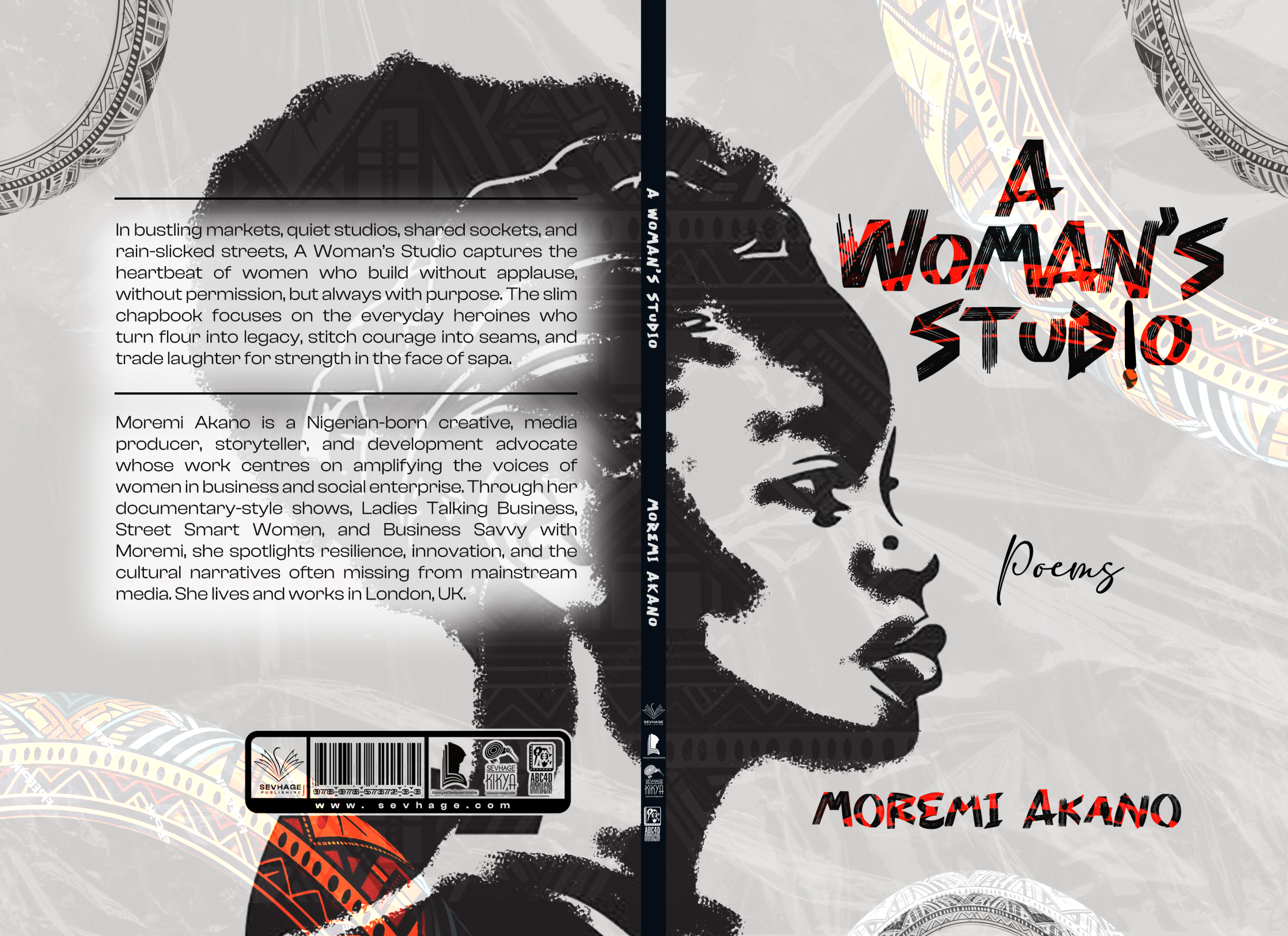
Moremi [Folake] Akano’s A Woman’s Studio is a slim chapbook of short but impactful poems, what one can call poetic vignettes that transform the often overlooked spaces of women’s labour into sites of art, meaning and resilience. The poems situate themselves in the markets, kitchens, and street corners of Nigeria and Africa by extension, but their reach extends well beyond geography. At their core, they are meditations on dignity in the face of struggle, and on the beauty of persistence in a world that rarely applauds it.

The strength of the collection lies in its rich cultural anchoring. Akano does not flatten her world for an external gaze; instead, she trusts readers to walk with her through the unvarnished realities of Nigerian life. In ‘Eko is a Woman,’ Lagos is personified as female , i.e. vibrant, unyielding, and endlessly resourceful. The imagery of egusi spilling into gutters, of women selling both “Ankara and attitude,” captures the paradox of a city that is both exhausting and life-giving. ‘The Woman with the Red Basin’ dignifies a street vendor dismissed as an “illiterate,” her head-load of wares reimagined as the weight of generations. These depicted African imagery and cultural details speak of larger truth, which is the ingenuity of women who must carve possibility out of scarcity. This, resonates universally.
Akano’s women are also seen as artists of survival. In ‘Unpolished Studios,’ we see them transform broken mixers and whispered prayers into tools of livelihood. In ‘Lessons from a Small Chair,’ we witness generational wisdom passed down not through books or institutions, but through the communal act of sitting, listening, and sharing. These stories echo with a familiarity that crosses borders. One does not need to have walked through Balogun Market or inhaled the scent of fried stew to recognise the quiet heroism of women making life work, often invisibly.
What makes this collection compelling to an international reader is its insistence on universality without erasure. A reader in London or Birmingham will hear in these poems the rhythms of immigrant markets, the resilience of women working night shifts, or the quiet persistence of mothers balancing childcare with other work. The imagery conjure easily recognisable universal emotions of perseverance, fatigue, hope, and small triumphs. In this way, Akano bridges cultural distance by foregrounding the shared heartbeat beneath different contexts.
The stylistic choice to maintain a largely uniform tone. It is measured, reverent, attentive and one can argue that it may risk monotony if approached in a single sitting. Many of the poems return to similar motifs: women who hustle, endure, and remake the world in small, everyday gestures. Yet, this repetition itself feels deliberate. It works less as redundancy than as refrain, a poetic insistence that these are not isolated stories but part of a wider, collective rhythm. The effect is closer to listening to a chorus than to a solo voice; the same tune carries, but with different textures. On another note, it speaks to the same fight that all women have to fight.
A Woman’s Studio is ultimately a work of witness that honours women’s labour as both economic necessity and cultural creation. In doing so, Akano reminds us that every woman’s space of survival, however modest, is a studio of meaning. These poems offer both a window into the Nigerian and African everyday and shows a mirror reflecting the uncelebrated labour in their own contexts. It extends to portraying the might of every woman everywhere calling them to stand up with all their might, without excuse, to make their lives count. The book’s strength lies, perhaps, in its quiet persistence. Like the women it portrays, it does not clamour for recognition, yet it lingers, asking us to see, to honour, and perhaps, to remember the studios of survival in our own midst.
Soji Cole is a multiple award-winning author, scholar, and Assistant Professor at St Mary’s University, Halifax, Nova Scotia, Canada. He is currently rounding off a second PhD program in Interdisciplinary Humanities at Brock University, Ontario Canada. He has been a double recipient of the Diversity Studies International Teaching and Scholarship Network Fellowship, with the University of Augsburg, and Carl Von Ossietzsky University, Oldenburg in Germany. He was a recipient of a Fulbright Research Scholarship at Kansas State University, Manhattan, USA. He also received a Pre-Doctoral Fellowship in Black Studies at Queens University, Ontario, Canada. He was a Guest Research Scholar at the Center for Research and Creative Exchange, University of Roehampton, UK. Amongst other prizes, he has won the [NLNG] Nigeria Prize for Literature; the Association of Nigerian Authors (ANA) Playwriting Prize; A winner of the International Federation for Theatre Research (IFTR/FIRT) New Scholars Prize, as well as a winner of the African Theatre Association (AfTA) Emerging Scholars Prize.


You must be logged in to post a comment.